Solar Shift in New Financing for Candian Solar, Trina
Doug Young Bottom line: New financing deals for Canadian Solar and Trina reflect the growing role of solar panel makers as power plant builders, and could provide some stability to the sector by providing a more reliable stream of new projects. Two big new financing deals are shining a spotlight on a major shift taking place in the solar panel sector, with manufacturers increasingly moving into the field of solar farm development. The shift is seeing solar panel makers become their own best customers, buying up panels for use in solar farms that they build themselves. The...
Solar City IPO: A Bit Pricey
by Debra Fiakas CFA Renewable energy retailer SolarCity has filed for an initial public offering of 10 million shares of its common stock and a few shares owned by existing shareholders. The offering is valued at between $130.0 million and $150.0 million based on an anticipated share price between $13 and $15 per share. SolarCity expects its shares to trade on Nasdaq under the symbol SCTY. Proceeds raised by SolarCity will be used support acquisitions of complementary operations. Proceeds could also be used to support SolarCity’s capital spending program as it seeks to extend its distributed network...

Unprofitable Sunrun Buys Unprofitable Vivint Solar
by Paula Mints
In July, Unprofitable residential solar lease company Sunrun (RUN) announced that it would acquire its unprofitable competitor, Vivint Solar (VSLR). Each share of Vivint stock will be exchanged for .55 shares of Sunrun’s common stock. Sunrun indicated that there were great synergies between the two companies.
Comment: Remember when Tesla (TSLA) adopted Solar City, a company founded by Elon Musk’s cousin? Sorry – remember when Tesla acquired money-losing Solar City and claimed strong growth and profits would follow? Great synergies. A wonderful future. Rainbows, kittens, and a profitable solar future for all.
The residential solar lease and residential PPA offers...
Solar Micro FiT 3.0 as an Investment
Brian Kennelly I am asked this question over and over again and I can answer quite emphatically, YES! Most think I answer that way because I’m a nut about renewable energy and sustainability and my business also sells solar arrays. These are valid points but I still maintain that the OPA FiT program is one of the best, secure and environmentally friendly investments you will ever make! Most people that know me probably are not aware that I was educated and began my career in finance and accounting. A very satisfying time, but alas my entrepreneurial urges got the...
Melting LDK Solar Looks for a Buyer
Doug Young There are quite a few developments on the solar energy front today, led by the release of new financial results from LDK Solar (NYSE: LDK), the weakest of China's major solar panel makers, that show a company in the midst of a meltdown. Meantime, Beijing has officially protested a US law that allows Washington to levy punitive tariffs against overseas industries that receive unfair state support, such as China's solar sector. Both the US and Europe believe China supports its solar sector with unfair subsidies and have taken various punitive actions; and now India is also...
Trina Warning Foreshadows Solar Gloom
Doug Young After watching their shares and prospects soar over the past year, solar stocks are suddenly hitting a cloudy patch as investors anxiously wait for most companies to return to the profit column following a 2 year sector downturn. That wait may have just gotten a lot longer, following a warning from Trina (NYSE: TSL) that it will fall far short of its previous sales forecasts for the just-ended first quarter. Trina blames the problem on short-term factors, as it and other Chinese panel makers work to finalize an...
Future Remains Bright For Solar Despite The Trump Tariff
by Thomas Byrne
Despite the Trump Administration’s assertion that it will benefit the solar industry, the decision to impose a tariff on solar panels will have the opposite effect. While attempting to prop up a handful of American manufacturing jobs that may never materialize, many more jobs installing solar systems are at risk as the pace of installations will slow. Some estimate as many as 23,000 jobs could be lost. But the solar industry has proven resilient through bigger threats, and the global demand for clean energy will eclipse this decision.
The remedy imposed by the Administration will have a few immediate impacts on...
The History and Future of Solar Shingles
by Kyle Pennell
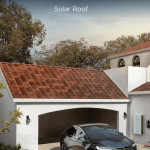
Back in late 2016, Tesla (TSLA) moved to acquire SolarCity, a solar panel manufacturer and installer. Shortly thereafter, the electric automaker revealed why: it had developed a new residential solar product, the solar roof. While it looked like any other home roof, the tiles that composed the roof actually contained solar cells. An individual roof tile won’t produce much energy, but when linked with others in sequence, the tiles can potentially generate power equal to that of regular solar panels.
But while Tesla’s solar roof energized the solar industry, it was hardly revolutionary. At the time of Tesla’s unveiling...
Company Failures Are Not Industry Failures
Dana Blankenhorn Nearly all the big computer companies of the early 1970s have since gone out of business. Remember the BUNCH? Burroughs, Univac, NCR, Control Data, Honeywell (HON)? The first two became Unisys, the last three are still around, but none is a real factor in the computer industry as it exists today. Betting on the BUNCH in 1971 would not leave you in the chips in 2011. Digital Equipment, Data General, Wang, Amdahl? All gone. Along with nearly every company that made PCs in the 1970s save one – Apple. International Business Machines Corp. (IBM) didn't get into the...
Metrics for Thin Film Solar CIGS Company Comparisons
Joseph McCabe Many people ask me, “which CIGS company is going to emerge as winner in the race towards high efficiency thin film PV’s? To provide an enlightened perspective to the question, some historical perspectives are needed. First Solar (FSLR) has helped the Thin Film PV Industry by proving that respectable solar to electric area efficiencies can be achieved in a low cost manufacturing processes, with respectable performance over time. First Solar’s technology is cadmium telluride (CdTe) on glass. Previously, amorphous silicon was the thin film leader, with the highest commercially available thin film area efficiencies; currently they...
Solar Stock Alerts
By Harris Roen Three companies in solar had gains yesterday. Duke made a significant acquisition; First Solar offered positive guidance; JinkoSolar posted an upsetting loss. Duke Energy Corporation (DUK) More Info Duke Energy Renewables acquired two PV power projects in Southern California. Highlander Solar 1 and 2 have a combined capacity of 21 MW, and have 20-year power purchase agreements with Southern California Edison. Operations should become commercial in mid-2013. This brings Duke to more than 100 MW of generating capacity. The stock is up 18% for...
Chinese Solar Sector Overhaul Goes Local
Doug Young The latest signs coming from bankrupt solar panel maker Suntech (NYSE: STP) indicate a Beijing-led overhaul for the struggling sector may not be coming after all, and that local governments and other stakeholders may instead become the main rescue agents for these companies. Reports last year had hinted that Beijing was working on a broad plan to retrench the sector, which was suffering from massive overcapacity. But since then most of the problems at the weakest major player LDK (NYSE: LDK), have been handled by the local government and other stakeholders in its home province of...
SunPower and SolarWorld: Strange Bedfellows
by Paula Mints
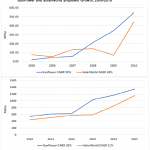
Oh, what a tangled web you weave when vying for an exclusion from tariffs via strategic ac-quisition. In April, SunPower (SPWR) announced it had acquired (subject to regulatory approval) So-larWorld US, subsidiary of the company that kicked off the solar tariff dispute with a petition in 2012, focused on China as the dumper of cells and modules. SolarWorld GmbH, based in Germany, could not file the petition. It needed its US subsidiary to do so. As SolarWorld US is, currently, the only crystalline cell manufacturer in the US, it takes on a value beyond the sum of...
Investing In Solar Innovation
By Jeff Siegel The road into the digital age has been paved with innovation. Everyday items have been electrified with panels and displays for endless possibilities of interaction. Automobile windscreens, household appliances, even walls and furniture are lighting up all around us, wired with sensors and displays that receive and transmit information. It seems the only surface left to electrify on this road to an everything-digital future is the roadway itself. Some folks believe one day soon, your local road network could be carrying not only the flow of vehicle traffic, but torrential flows of digital data and...
India Hates Coal
By Jeff Siegel If you think the war on coal in the U.S. is bad, you ain't seen nothing yet! We recently got word that India is set to double the tax on coal production, while promoting electric vehicles and renewable energy projects. I'm pretty sure there's some Luddite reporter in Mumbai right now who's head's about to explode. But that's neither here nor there. While I'm no fan of regulatory regimes of any kind, I'd be lying if I said I wasn't happy to know that a crap-ton of money is getting funneled into renewable energy and electric...
Finding the Apple Computer of Solar Power
by Joseph McCabe, PE Have you noticed the corporate pitches that compare their products to iPhones or iPads to try and force the feeling that they are "like Apple"? Bill Ford just pitched the Ford electric car in this manner. If Apple is the gold standard, the question becomes, what solar company is closest to being just like Apple? I think the answer is none, at least not yet. The Apple Model Apple has a design culture that attracts design professionals to their product. They also have a completely vertical integrated product where their case, graphical...