May 21, 2013

The Farm Bill: 5-Minute Guide to the Energy Title

  Jim Lane
5 min clock.jpg
Only 5 min BigStock Photo

What’s in that Durn-tootin’ US Farm Bill, anyhow?

For the harried taxpayer, some relief. For energy security and rural economic development, targeted investments that now head to the legislative floor.

Here are the need-to-knows.

In Washington, the House and Senate Agricultural committees have now passed their respective versions of the proposed 2013 farm bill, which would take effect for fiscal 2014 through fiscal 2018.

Both bills have energy titles — meaning that, should they find passage, as expected this summer, in the House and Senate, the measures in the Energy title will come up for negotiation in the House-Senate conference, but not the existence of the title itself. In today’s Digest, we look at the two different versions of the Energy title — what’s getting funding, what’s not — and how much, and how.

Weighing the bills

The Senate’s bill weighs in at 1150 pages, no ounces — the House Bill at a comparatively light 576 pages.

The Overall Farm Bill

The Senate version reduces spending by $18B over the previous Farm Bill ($24.4B if the sequestration provisions are repealed by Congress, which itself slashed $6.4B), to $955B over a 10 year period between 2014 and 2023.

The Energy Title

Overall spending on the Energy Title is increased by $780M (2014-2023) under the proposed Senate version.

By section, the changes are

Biorefinery Assistance — $216M
REAP — $240M
Biomass R&D — $130M
BCAP — $174M
Other programs — $20M

Timeline to passage

House Ranking Minority Member Collin Peterson said, “With today’s action, I’m optimistic the farm bill will continue through regular order and be brought to the House floor in June. If we can stay on track, I think we should be able to conference with the Senate in July and have a new five-year farm bill in place before the August recess.”

The Details

Definitions

The House Bill does not add language to include renewable chemicals under the provisions of an Energy title — the Senate does.

Biobased Markets Program

Both the Senate and House include a biobased markets program. The House voted $2 million in discretionary funding (e.g. subject to annual appropriations). The Senate expanded the program’s scope to include assembled products, expands outreach and educational efforts, a study on market impact — and adds $3 million in mandatory funding from the Commodity Credit Corporation in addition to the $2M in discretionary funding offered by both the House and Senate.

Biorefinery Assistance

The House offered $75M per year here in discretionary funding, while the Senate offered $100M in for 2014 in mandatory funding and $58M in each of 2015 and 2016. The Senate also broadened the language to include renewable chemicals and biobased materials.

Repowering Assistance Program

The House authorized $10M for the program per year in discretionary funds, while the Senate did not vote funding.

Bioenergy Program for Advanced Biofuels

The Senate Bill authorizes $20M annually in discretionary funds, while the House authorizes $50M per year, also discretionary.

Biodiesel fuel education program

The Senate version keeps this program intact, but changes it from discretionary to mandatory funding. The House version doubles discretionary funding to $2M per year.

Rural Energy for America Program (REAP)

Both the Senate and House versions ask the Secretary to develop a three-tiered application process (for projects costing up to $80K, 80-2200K, and over 200K) and structure the comprehensiveness of the information required according to the cost of the program. The House version authorizes $45M per year in discretionary funding. The Senate offers $20M in annual discretionary funds, and $68M in mandatory funds via the Commodity Credit Corporation.

Biomass Research and Development

The Senate version offers $30M in annual discretionary funding, and $26M in mandatory annual funds. The House version authorizes $20M in annual discretionary funding.

Feedstock Flexibility Program

Both the Senate and House voted to extend this little-known, no-cost program through 2018. It’s purpose:

For each of the 2013 through 2018 crops, the Secretary shall purchase eligible commodities from eligible entities and sell such commodities to bioenergy producers for the purpose of producing bioenergy in a manner that ensures that section 7272 of this title is operated at no cost to the Federal Government by avoiding forfeitures to the Commodity Credit Corporation.

Biomass Crop Assistance Program

The House version eliminates the prohibition on animal, food or yard waste, and algae — and strikes the authorization to “assist agricultural and forest land owners and operators with collection, harvest, storage, and transportation of eligible material for use in a biomass conversion facility.” The House also increases funding from $20M to $75M per year, but changes this from mandatory to discretionary funding.

The Senate version adds a prohibition on funding “invasive species” and restricts use of lands enrolled in the conservation reserve program or is native sod — and generally prohibits food crops. The Senate version also sets a maximum BCAP term of 5 years for annuals or perennial crops and 15 years for woods.

Towards collection and harvesting, a maximum of $20 per ton for up to four year, on a matching dollar basis.

The Senate authorizes $38.6M per year in mandatory funding.

Forest Biomass for Energy program

The Senate voted to repeal the program, while the House version simply ignores and thereby effectively kills by de-funding.

Community wood energy program

The Senate voted to keep this program at $5M per year in discretionary funding, while the House version votes to reduce annual funding to $2M.

The Senate also creates a new category of ‘biomass consumer cooperative’ —”a consumer membership organization the purpose of which is to provide members with services or discounts relating to the purchase of biomass heating products or biomass heating systems.’’ and offers grants of up to $50K towards the establishment of expansion of such cooperatives.

The Bottom Line

It’s not a visionary Farm Bill for Energy — more about fine-tuning and maintaining provisions that were originally introduced in 2002 and 2008. But there’s a lot more meat on the bone, so to speak, with $780M in increased funding over a 10-year period.

On the other hand, it’s not a hugely expensive program when seen in the context of the federal budget — representing an addition expenditure of $0.26 per capita, per year.

There isn’t all that much for a House-Senate conference to bicker about — primarily, the status of renewable chemicals on the downstream side, and the inclusion of various new types of crops on the upstream side.

And there are funding differences that need to be ironed out – in particular, the balance between mandatory funding and discretionary embraced in the Senate version – while the House generally opts for a discretionary approach, especially for high ticket items.

There’s language in the BCAP program that will need to be settled out.

The Digest continues to point to opportunities for the creative use of Conservation Reserve program land — sensitive to and subject to hunting and environmental uses — for bioenergy projects, and thereby highlights the prohibition on BCAP funds being used for CRP lands, as envisioned in the Senate version of the bill (but not the House bill). We hope the House and Senate come to a creative mutual approach on this provision.

Read More:

Jim Lane is editor and publisher  of Biofuels Digest where this article was originally published. Biofuels Digest is the most widely read  Biofuels daily read by 14,000+ organizations. Subscribe here.

advertise here


May 21, 2013

Ameresco, New Flyer, PFB: Q1 Efficiency Earnings Highlights

Tom Konrad CFAAmeresco logo

Performance contractor Ameresco, Inc. (NYSE:AMRC) reported earnings on May 9th. Revenues were below analyst expectations, but Chairman, CEO, and President George Sakellaris put this down to timing issues, and stuck by his full year guidance. Strong growth in the firm’s backlog and awarded project’s seem to back up this relatively optimistic view.  From the earnings call transcript

[W]e are very confident about the improving market conditions in few of our regions, as well as continued growth in our all other offerings. These are expected to be the growth drivers for the near-term. We are also very confident about the medium to long-term pipeline development, as shown by the continued increase in awarded projects. Where we are cautiously optimistic near term, is the select areas where we continue to see softness in the awarded project conversion rates. The varying conversion rates at the local level lead us to believe that overall market conditions will improve gradually over time. We continue to believe, however, that energy efficiency represents a large growth opportunity over the long-term. We are excited about our own growth or potential within this market opportunity, given our leadership role, as well as our current pipeline development. As a result, we are very optimistic about the long-term fundamentals of our business.

Sakellaris’ comment re-affirm my view of the company, which I have been repeating all year.  At $7.50, this is a great opportunity to acquire one of the leading companies in the energy efficiency space.

new flyer logoLeading North American transit bus manufacturer New Flyer Corp (TSX:NFI, OTC:NFYEF) reported increased revenue on higher bus deliveries and the acquisition of Orion’s aftermarket parts business.  The company continues to grow its backlog rapidly, and demand for new buses looks likely to remain strong, despite a 5% cut in US federal funding for transit buses due to sequestration.   Bus ridership and state tax revenues (which also fund bus purchases) have been strong.

The company continues to look for attractive acquisition targets (such as Orion’s parts business), to be funded by the investemtn from Brazillian bus manufacturer Marcopolo announced in January.

New Flyer expects to maintain its current C$0.585 annual dividend.

PFB Corp logoGreen Building company PFB Corporation (TSX:PFB, OTC:PFBOF) also announced first quarter results.  Year over year, comparable revenues and earnings were slightly down from the first quarter last year.   In my opinion, this is most likely due to the much colder weather than in 2012, which would have slowed building conditions.  Going forward, I expect to see earnings growth for the rest of the year. The first quarter also included a previously announced sale and leaseback of four of PFB’s Canadian properties, resulting in a one-off after tax gain of C$6.2 million, or 92 cents a share.  The proceeds will be used to pay off all PFB’s debt and pay a special C$1 dividend, in addition to its regular C$0.06 quarterly dividend.

Management has good reason to return cash to shareholders when they can: the company is 70% owned by insiders.

Oh, yeah, and Tesla (NASD:TSLA) also announced very strong earnings.  Long time readers know I don’t follow “popular” stocks, but I’m happy to see good news for electric cars. The fairy dust from high profile stocks like Tesla tends to fall on all green stocks, and increase valuations across the board.

Disclosure: Long AMRC, PFB, NFI. 

This article was first published on the author's Forbes.com blog, Green Stocks on May 9th.

DISCLAIMER: Past performance is not a guarantee or a reliable indicator of future results.  This article contains the current opinions of the author and such opinions are subject to change without notice.  This article has been distributed for informational purposes only. Forecasts, estimates, and certain information contained herein should not be considered as investment advice or a recommendation of any particular security, strategy or investment product.  Information contained herein has been obtained from sources believed to be reliable, but not guaranteed.

May 19, 2013

Does Buying Green Stocks Do Any Good?

Tom Konrad CFA

Volt owners are almost universally happy with their cars, despite the fact that very few will recoup the extra costs of the car in gas savings.   Even though the financial savings are small compared to the large up front payment for the vehicle, the emotional payback more than compensates.

As someone who helps people invest in green stocks, I can tell you from first hand experience that investor enthusiasm has everything to do with recent financial returns, and not much to do with the good we’re doing.

In 2007, when practically any stock which could be labeled green was going stratospheric, my phone was ringing off the hook.  Then came the crash in 2008, with green stocks falling more than the market as a whole.  Worse, they failed to participate in the market recovery since then.  Green investors are a dedicated lot.  Many of my clients worried that the slump might never end, but none left.  But the calls from new clients became very few and far between.

Finally, in late 2012, green stocks began to rally.  The leading clean energy ETF, PBW, is up 40% from its November low.  The leading solar ETF, TAN, is up 65% from its low.

The phone is ringing again.

Why the Difference?

To judge by the comments from Volt owners, their enthusiasm has a lot to do with the regular thrill they get driving by a gas station without stopping.  Whenever they drive, they are reminded that they’re doing good for the environment.  This makes them feel good, and that feeling keeps them feeling good about their cars, even without positive financial returns.

A green stock portfolio is different.  Few investors make the emotional connection between their green stocks and the success of green companies.

Too Cerebral

Green money managers, in general, are not much help.  I asked my panel of thirteen green money managers, ranging from investment advisors to hedge fund managers how buying green stocks helps green companies.  Here is a sample of their responses:

Investment advisor Jan Schalkwijk, CFA at JPS Global Investments:

In theory, higher demand for green stocks –  to which small investors would contribute by purchasing green stocks, mutual funds, and ETFs – should decrease the cost of capital for these companies, thus improving their ability to expand. Additionally, to the extent that the purchase is funded by a redemption of a non-green stock, this should increase the cost of capital for that company; thus reducing its scope for expansion. However, I don’t think small investors have enough clout to make this theory pan out in reality. It really requires big buy-in from large investors to make a dent.

Solar hedge fund manager Shawn Kravetz at Esplanade Capital:

[T]he small investor is in effect providing capital to the green company and depriving capital of other alternatives.  While the green company has already raised the actual capital, the market purchase fuels demand for that sliver of ownership and in essence rewards the green company, making it easier and lower cost for them to raise more capital in the future and thereby spread their greenness.  One investor does not move the needle per se, but the sum of multiple such investors indeed does.

That’s all true, but it does not exactly get the heart racing.  Schalkwijk, Kravetz and I are immersed in the stock market on a daily basis.  To us, moving the price of a stock a smidgen is very real, we do it and see its effects regularly.  To the average small investor, however, this logic must seem hopelessly abstract.

Your Money, Direct to Clean Energy Projects
Fortunately, it’s not the whole story.

With the arguments for investing in green stocks so intellectual, it’s no surprise that even the most environmentally minded prospective investors are more interested in last month’s returns.

On Monday, I spoke to John Fullerton is the Founder and President of Capital Institute.  The Capital Institute’s mission is to transform finance to effect a more sustainable economy.  Its focus is on large institutional investors such as pension funds and endowments, but he agreed to speak with me about my personal focus: small investors.

In general, Fullerton thinks that the focus on trading in the stock market makes it very difficult for the sustainable investor to affect change.  But he sees some exceptions.  In particular, Master Limited Partnerships (MLPs) and REITs return their cash flows to investors, so they need to conduct secondary offerings (sell shares) whenever they make new investments.  Investors in these vehicles are buying the future cash flows derived from the expansion of the enterprise, not just speculating on a future stock price.

At the moment, the MLP structure is limited to depleting resources such as fossil fuels and their transport, and so are not likely to be of interest to green investors.  However, the MLP Parity Act, which was designed to correct this imbalance, has been re-introduced in the Senate with bipartisan support.  If the act passes, small investors will have the opportunity to invest in publicly traded MLPs which will directly use the money to fund solar, wind, geothermal, and other clean energy projects.

For now, there are two publicly traded REITs investing in clean energy projects.  The larger of the two is Hannon Armstrong Sustainable Infrastructure (NYSE:HASI), which went public last month and is investing the proceeds in eight clean energy projects that it had lined up in preparation for the IPO.  Since Hannon Armstrong is a leading financier of clean energy projects, investors can be confident that secondary offerings to fund other projects are not too far in the future.  By buying and holding HASI, they increase the amount of money the company can raise for new projects with a fixed amount of stock.  The profits from those projects will then be returned to the investors as dividends.

With the second clean energy focused REIT, Power REIT (NYSE:PW), the connection between the small investor and the clean energy project they are financing is even more direct.  Power REIT has just signed a term sheet for the acquisition of 100 acres of California land underlying approximately 20MW of to-be-constructed solar projects for $1.6 million.  PW will fund that purchase with a combination of debt and equity.

The equity will be raised by the company selling stock through a broker on the New York Stock Exchange under PW’s existing At Market Issuance Sales Agreement.  In other words, if you buy the stock today, there is a good chance that the money won’t go to another investor; it will go straight to Power REIT to fund a solar farm.  Even new investors who buy from other investors are directly helping by keeping the price up and ensuring that for every share PW sells as much money as possible helps finance the solar farm.  Profits from the solar farm will then flow back to Power REIT and be returned to investors as dividends.

Venture Capital

Many small investors wanting to make an impact envy the venture capitalists (VCs) who can fund a start-up green technology company with a better battery or a more efficient wind turbines design.

They should not be jealous.  VCs take their cues from the stock market, not the other way around.  Without the stock market and the ability to sell a company to ordinary investors in an IPO, the only ways for venture capitalists to get a returns on their investments would be to sell them to other companies, or wait for the start up to generate enough profits to pay them back itself.

Many VC-backed companies are sold to other firms, but this is a second choice option, mostly used when stock market valuations are low.  Waiting for a start-up to pay back its initial investors is simply not an option of VCs: the returns take too long.   They prefer the money sooner, in five to ten years at most, so they can move on and fund the next promising start-up.

Because VCs count on IPOs for their best returns, they’re much more likely to fund start-ups in sectors with high valuations.  When  solar stocks are in the stratosphere, VCs fund solar start ups.  When Smart Grid stocks are all the rage, VCs will be looking for the next great smart grid technology.

It’s not only First Solar’s (NASD:FSLR) management and shareholders who are paying attention to FSLR’s share price.  It’s VCs, and all the entrepreneurs hoping to get those VCs to fund the next breakthrough solar technology.

We’re Invested in More Ways Than One

In addition to pointing out that buying a green company helps its stock price, Shawn Kravetz made another point:

[W]hen people own stocks they tend to patronize and talk about those companies.  This vested interest and evangelism, when aggregated, does move the needle.

Fullerton makes a similar point in a recent blog post.  He argues that we should understand investment in the context of a holistic decision-making process that seeks to harmonize (not trade off) financial, social, and ecological objectives.

Both are saying that it’s too simple to just look at the effect our investment are having on companies, we also have to consider the effect our investments have on us.  People whose retirement depends on the continued profits of a coal companies are much more likely to give those companies a sympathetic ear when they complain that regulations to limit mercury emissions (or any other environmental harm) are too expensive and will undermine their profits.

If we invest in companies that stand to lose from the shift to a sustainable economy, the vested interests we are fighting are our own.  Much better to invest ourselves, both financially and emotionally, in companies that will benefit from the changes we know must be made to protect our planet and our children.

Conclusion

Even the smallest investors’ green investments make a difference.  This is most direct when they buy the shares of companies  in the process of raising money for green investments.  Yet they also makes a difference to a company’s ability to reward valuable employees with shares or options, and to the prospects of start-ups in similar industries.   Higher prices for green stocks mean more green companies having successful IPOs, and more green start-ups secure funding.

Perhaps most important are the effects owning a slice of a green company has on the investor.  It is much easier to make the right decisions for the planet and our future when we know the stocks we own will benefit from those decisions as well.

When green investors understand the very real changes their investments are having on the world, perhaps they’ll love their portfolios as well, like Volt owners love their cars.

Disclosure: HASI, PW

This article was first published on the author's Forbes.com blog, Green Stocks on May 8th.

DISCLAIMER: Past performance is not a guarantee or a reliable indicator of future results.  This article contains the current opinions of the author and such opinions are subject to change without notice.  This article has been distributed for informational purposes only. Forecasts, estimates, and certain information contained herein should not be considered as investment advice or a recommendation of any particular security, strategy or investment product.  Information contained herein has been obtained from sources believed to be reliable, but not guaranteed.

May 16, 2013

Ten Economic Risks of Fossil Fuels

Garvin Jabusch

320px-Train_Crash_Cerhovice_1868_Chalupa[1].jpg

A train, loaded with coal, crashed into the back of a passenger train in Czechloslovakia in 1868.

Securities of fossil fuels firms, as an economic sector, may soon be on the decline. Predictions as to when oil, gas and coal will become a smaller part of the investment society makes into its total energy mix in favor of renewables (such as solar, wind and ocean energies) vary, ranging from 2060 on the long side (this prediction from oil industry powerhouse Shell) to 2030 or even sooner on the shorter side (as reported by Bloomberg). But so far, markets appear to be mispricing the risk this presents to fossil fuels companies, and their share prices for now remain stable. In our opinion, it’s not too soon to consider divesting from fossil fuels while one might still recover significant value.

Coal, oil, and natural gas, though, are the main sources of energy that have gotten civilization this far (at least since the late 1700s, or the entire industrial revolution), so why are many expecting them to so quickly diminish in importance? 

Mostly because of recent innovation and renewable energies’ efficiency and cost gains. Our ‘next economy’ thesis asserts that the energy and material resources we need to host an indefinitely thriving economy exist in more than sufficient quantities (particularly energy), if we would only collect and use them in smart and efficient ways. The innovations required to put world economies on a long term sustainable path largely exist today. For example, the various forms of solar energy collection have become so efficient over the last 20 years that all of civilization’s energy requirements could presently be met by covering 0.3% of the earth’s land surface with solar panels and concentrated solar thermal systems. Our models insist that through promoting true sustainability solutions in materials and energy, we can indeed maintain a healthy, thriving biosphere, all while growing our economies and improving standards of living potentially everywhere, for everyone.

This in mind, we put together 10 primary reasons why fossil fuels investments, in next economy terms and indeed in general economic terms, no longer appear to be the attractive source of risk-adjusted returns they have historically been.

Fossil fuels are economically becoming subprime because:

1. Fossil fuels have the capacity to threaten basic systems.

Warming and its sequelae such as severe weather, droughts, floods, more frequent and intense storms and attendant uncertainties all undermine our basic economic foundations. A recent World Bank report conceded that “There is … no certainty that adaptation to a 4° C world is possible,” referring to a global average temperature increase of 7.2 degrees Fahrenheit from pre-industrial times that is considered likely by scientists over the next few decades if fossil fuels’ use is not soon severely limited. To rephrase what this means, the traditionally conservative World Bank believes that human economies may not be able to adapt to a world that has on average warmed four degrees Celsius or more. Note that the global temperature has risen nearly one degree Fahrenheit since 1975.

Millions of pages have been written on the underlying reason for the unsustainability of fossil fuels. Their power to disrupt basic climate and therefore world societies is vast, complicated and is a topic best left to our best specialists. I suggest to the interested reader the works of more qualified practitioners including Dr. James Hansen, Lester Brown and Bill McKibben.

2. Fossil fuel assets present abandonment risk.

Fossil fuels companies are now confronted by the risk that many of the still-in-the-ground assets they count on their balance sheets and/or in their future revenue projections may never be recovered or realized. As this becomes the apparent, their asset valuations and revenue guidance may be revealed as currently far too high, and the values of their companies and stocks overvalued. Citing abandonment risk, Bloomberg recently reported that “Investors in carbon-intensive business could see $6 trillion wasted as policies limiting global warming stop them from exploiting their coal, oil and gas reserves.”  Carbon Tracker reports that “Between 60-80% of coal, oil and gas reserves of publicly listed companies are ‘unburnable’ if the world is to have a chance of not exceeding global warming of 2°C.”

The press down under is reporting that “Australian based analysts at Citigroup say fossil fuel reserves in Australia face significant value destruction in a carbon constrained world, with the value of thermal coal reserves likely to be slashed dramatically if governments get serious about climate action…Fossil fuel asset owners could be best advised to dig the resource up as quickly as they can.”

Over at HSBC they recently pushed up a similar report, encompassing a global scale, essentially saying we can’t count all the fossil fuel reserves on firms’ balance sheets because we cannot burn them all and therefore “Oil and gas majors, including, BP, Shell and Statoil, could face a loss in market value of up to 60 percent should the international community stick to its agreed emission reduction targets.” (As reported by GreenBiz.com.) (I don’t believe most policymakers in governments around the world currently have the wherewithal to honor their various carbon reduction treaties, but I also don’t believe that matters. Peak oil demand is upon us because the alternatives are simply becoming far more competitive and because awareness of fossil fuels’ dangers is rapidly advancing.)

What Bloomberg, Citi and HSBC are saying, in sum, is that infinite growth of a known harmful asset – in this case an asset with the ability to disrupt climate and civilization – must come to an end, and soon.  And shares of the firms exploiting this asset are at risk.

3. Renewables are becoming too competitive for fossil fuels.

Forbes has quoted Rick Needham, director of energy and sustainability at Google saying, “While fossil-based prices are on a cost curve that goes up, renewable prices are on this march downward.” That pretty much sums it up. In just the last five years, solar photovoltaic module prices have fallen 80 percent and wind turbines have become 29 percent less expensive. Moreover, after the initial investment, renewables such as wind and solar, having no cost of fuel, will prove far too competitive for fossil fuels no matter how cheap those may appear to be. Cheap fuel is still more than free fuel.

One of the first major investors to recognize this was Warren Buffett. Via his MidAmerican Energy subsidiary, he has quietly made Berkshire-Hathaway America’s single largest owner of both solar and wind electrical power generation capacity. Patrick Goodman, Buffett’s CFO of MidAmerican said simply “we believe renewables is the better investment right now.” Warren Buffet, who believes that once a good investment has been identified it’s time to “back up the truck,” is showing no signs of giving up his leader status on solar, having just begun construction on the “largest solar plant in the world.”

All this is happening now, today, with today’s technologies and today’s economics. That the smart money already sees renewable energies as more competitive long term than fossil fuels is obvious. The ‘smart money,’ by the way means individuals as well as institutions. Solar crowdfunding pioneer Mosaic in April of this year sold out the first tranche of $100 million in solar project investments to Californians in just hours.

Further technological advances aren’t required to make renewables competitive, but advances are occurring. Fossil fuels will represent only a small percentage of all energy investments in just a few years for a simple reason: few will want to invest in the less profitable technologies of the past.

4. Fossil fuels firms are beginning to have to pay for their externalities.

Fossil fuels companies have never had to pay for their economic externalities such as pollution, warming, health effects and contaminated water and farmland. There are signs that this is beginning to change, and firms will increasingly be liable for damages in the tens if not hundreds of billions. The highest profile example is BP’s Deepwater Horizon spill, the worst oil spill in U.S. history. BP has already been required to set up a US$20 billion fund to cover cleanup and damage costs, and perhaps far more significantly, is facing potentially “tens of billions” in additional damage payments pending the outcome of what the Financial Times is (in a dedicated section) calling the “trial of the century,” now underway in Louisiana. The FT is also reporting that BP is facing an additional 2,200 lawsuits related to the spill. Even if BP should prevail in most or even all of these suits, the massive costs of these litigations will start to become a drag on the firms’ traditionally easy profitability. Newsweek has a longform piece covering many details including additional BP liabilities such as: “that BP lied about the amount of oil it discharged into the gulf is already established. Lying to Congress about that was one of 14 felonies to which BP pleaded guilty last year in a legal settlement with the Justice Department that included a $4.5 billion fine, the largest fine ever levied against a corporation in the U.S.” BP’s continuing potential liabilities from this one incident, including “uncapped class-action settlements with private plaintiffs” and “civil charges brought by the Justice Department” and “a gross negligence finding [that] could nearly quadruple the civil damages owed by BP under the Clean Water Act to $21 billion,” show the danger to shareholders. Any representative of an asset class carrying this kind of risk can justifiably be labeled a subprime investment.

Other firms facing liability issues surrounding the dangerous nature of their products include Chevron, which has had to abandon Ecuador altogether to avoid paying a $US19 billion settlement there in a “nightmare case” that threatens to drag on around the world as Ecuador seeks payment via Chevron’s assets in other nations.

5. Fossil fuels are likely to have to face carbon taxes.

There will be carbon taxes in many if not most countries that will directly impact the profit margins of fossil fuels firms. The New York Times Op-Ed framed the argument like this:

“Substituting a carbon tax for some of our current taxes — on payroll, on investment, on businesses and on workers — is a no-brainer. Why tax good things when you can tax bad things, like emissions? The idea has support from economists across the political spectrum, from Arthur B. Laffer and N. Gregory Mankiw on the right to Peter Orszag and Joseph E. Stiglitz on the left. That’s because economists know that a carbon tax swap can reduce the economic drag created by our current tax system and increase long-run growth by nudging the economy away from consumption and borrowing and toward saving and investment.”

A carbon tax is good for everyone but fossil fuels companies, who will see their profits reduced (or attempt to pass the costs on to consumers, reducing demand for their products further). So far, several nations, provinces and individual municipalities have implemented a carbon tax, and many others have carbon trading schemes (the Carbon Tax Center is a good resource for keeping up with these). Carbon taxes can raise revenues, shrink deficits, and move tax burden away from citizens, all while slowing the worst effects of warming. Look for their implementations to continue to spread.

6. Fossil fuels will soon face diminishing governmental subsidies and benefits.

Fossil fuels have received as much as half a trillion dollars per year in subsidies from the U.S. alone. To the extent that austerity or desires to balance budgets, combined with legislation to limit greenhouse gas emissions, reduce the scale of this windfall, the seemingly easy profitability of these companies will be undermined. This point, as well as point five above, is more fully developed in point seven.

7. There is growing global institutional belief that transition to renewables solves climate AND economy.

We’ve already seen the dire warnings about warming coming from the World Bank, and discussed the positions of Bloomberg, Citi and HSBC. These institutions are far from alone. The International Monetary Fund, in calling for “Energy Subsidy Reform,” recently calculated that between directly lowered prices, tax breaks, and the failure to properly price carbon, the world subsidized fossil fuel use by over $1.9 trillion in 2011 — or eight percent of global government revenues, representing a huge drag on economies. The United States taxpayer is fossil fuels’ largest benefactor at $502 billion in 2011. China came in second at $279 billion, and Russia was third at $116 billion. For perspective, that $502 billion is just over 3% of the US economy, currently being given away to big fossil fuels companies.

The IMF concluded that the “link between subsidies, consumption of energy, and climate change has added a new dimension to the debate on energy subsidies.”  The IMF’s solution to both economic and climate risk (as reported by The Hill) is in two simple parts: “end fossil fuel subsidies and tax carbon.”  The solution to both climate and economy is worldwide conversion from fossil fuels to renewables.

8. Fossil fuels are the ultimate non-circular: they’re completely consumed upon first use, so more primary source extraction is required.

As I mentioned above, to get global economies on an indefinitely sustainable foundation, we need to make far more efficient use not only of energies but also of raw materials. Fossil fuels represent both raw resources and energy sources, and they represent the worst of both. Smart, efficient use of materials means reusing nearly everything at the end of its lifecycle to repurpose into something else we need. For a thriving, sustainable long-term economy, we need to get close to perfect recycling of resources of all kinds so we can minimize our depletist impacts on earth and avoid the basic environmental degradations that go along with those.

This approach of course excludes fossil fuels and other resources that are consumed entirely on their first use. Raw materials can keep economies growing for a long time if we preferentially mine our huge stockpiles of already extracted resources and minimize extraction from primary, geological sources. But fossil fuels, unlike materials used to make solar panels and wind turbines, don’t work like that. Since they are consumed entirely on their first use, reuse is impossible and we have to literally go back to the well for more. This means ever more greenhouse gasses in the atmosphere, ever more degrading of the local environments where extraction takes place, ever more risk of accidents, and the possibility of eventually exhausting the resource completely (although on this last point I personally believe we will – for the reasons presented here – reach peak demand far before we fully exhaust fossil fuel reserves).

9. Distributed renewable energy grid is more secure than traditional hub and spoke systems, even those powered by domestic fossil fuels.

FERC Chairman Jon Wellinghoff has recently said, “It wouldn’t take that much to take the bulk of the power system down. If you took down the transformers and the substations so they’re out permanently, we could be out for a long, long time,” and “A more distributed system is much more resilient…Millions of distributed generators can’t be taken down at once.”

This is common sense. And short of equipping every home and business with its own diesel or natural gas generator – which of course would be disastrous for local areas’ air quality – fossil fuels can never offer anything like the kind of security and resilience that distributed renewables like rooftop solar can.

10. Renewables will counter fossil fuels’ endless ‘boom and bust’ economic cycles.

As I’ve posted before, the price of oil and other fossil fuels has, at least since World War II, been the main control knob permitting expansion and causing contraction of world economies. It’s widely known that 10 of the last 11 major recessions were preceded by peaks in oil prices. Rising oil prices are inflationary, adding to the costs of almost everything from transportation to fertilizers to plastics, and they therefore cause demand for all these affected items to become depressed, slowing economic production.  Renewables, relying as they do on free fuels like sunlight, present no such economic pressures, and as they become an ever larger percentage of our energy mix, fossil fuels’ huge GDP drag will begin to disappear.

Conclusion                                                              

What then is the future for fossil fuels versus renewables? Fossil fuels have already begun to rapidly lose market share. In 2012, most new electricity generating capacity brought online in the United States was from renewables, and in January and now March 2013, all new U.S. electrical generating capacity was provided by renewables. So where is this headed?

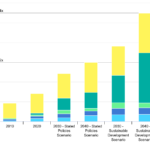
Clean Energy Investment Projection
Image courtesy BNEF

Bloomberg New energy Finance (BNEF) has calculated that “70% of new power generation capacity added between 2012 and 2030 will be from renewable technologies (including large hydro). Only 25% will be in the form of coal, gas or oil.” BNEF CEO Michael Liebreich has said "I believe we're in a phase of change where renewables are going to take the sting out of growth in energy demand," which goes to our thesis that we can both lighten our ecological footprint and increase our standards of living.

So add Bloomberg to the growing group of financial analysts warning that fossil fuel investments are poised to become a bad bet. 

Citi bank, in its note about the Australian coal industry, went as far as to warn investors that it will be difficult to extract value from their still-in-the-ground resources as action on climate change advances, stating, "If the unburnable carbon scenario does occur, it is difficult to see how the value of fossil fuel reserves can be maintained, so we see few options for risk mitigation." (Italics added; Source.)

Well, with all due respect to Citi, I can think of one option: we, like Buffett and Google, can instead invest in civilization’s non-carbon sources of power. As the IMF pointed out, the solution to both climate and economy is worldwide conversion from fossil fuels to renewables. This massive conversion program will lead to powerful economic growth, less economic drag from energy costs, higher revenue for treasuries, and strong employment drivers.

If we fear for the future, it is paradoxical to attempt to mitigate risks by remaining invested in fossil fuels. What we do now will bring about the future for better or worse. If we’re to emerge from our 19th century energy system, it must be us, now, today, who set that emergence in motion. Leave fossil fuels for those who prefer to look backwards.

Garvin Jabusch is cofounder and chief investment officer of Green Alpha ® Advisors, LLC. He is co-manager of the Shelton Green Alpha Fund (NEXTX), of the Green Alpha ® Next Economy Index, and of the Sierra Club Green Alpha Portfolio. He also authors the Sierra Club’s green economics blog, "Green Alpha's Next Economy."

May 15, 2013

SolarCity: Mixed Results But Good Prospects

By Harris Roen

SolarCity (SCTY) has been one of the hottest alternative energy stocks since its Initial Public Offering five short months ago. Yesterday it shot up 24% in one day, on the largest one-day volume since it opened, in anticipation of its quarterly earnings release. It is up 95% in the past three months, and has more than tripled from its initial trading price. As of this writing SCTY has given back about a third of yesterday’s stratospheric gains.

Now that earnings have been released, let’s take a grounded-in-reality look at this innovative solar company.

Scty Revenue and Income

SolarCity’s earnings results were mixed, showing steady revenues, but also a net loss for the first quarter of 2013 (chart above). It’s disconcerting that net income has been negative for the past four quarters, and on a per share basis, the most recent losses were 28% greater than analyst expectations. Revenues, on the other hand, came in ahead of analyst estimates, but just barely.

If SolarCity is to make it as a company, it needs to successfully implement a business plan that grows its customer base in a big way. It therefore makes sense to look at data relating to its clients. The chart below shows data for each of the past four years, and compares it to the most recent quarter.

SCTY Clients

Customer growth remains robust for the first quarter of 2013. 2012 was off the charts, with SolarCity adding on 30,950 new clients. The first three months of 2013 added close to a quarter of that number, which is good news for FY 2013 projections.

Total revenue per customer is declining steadily, but that is to be expected as the number of customers dramatically increases and the price of solar panels falls. What is occurring though (and what we want to see) is that the net loss per customer is steadily decreasing. It has changed from a low of around $5,000 in 2010 and 2011, to about $500 in the most recent quarter. If SolarCity can keep that trend going then the company will soon be in the black again. Another important metric is the acquisition cost per customer, which has remained steady at 2012 levels.

SCTY debt

I also find it encouraging that SolarCity’s debt levels remain reasonable, just about the same as 2012 levels. It is important to understand that in many ways SolarCity is a financial company, crafting and offering creative finance options to allow clients to get solar done with minimal up-front costs. As with other financial firms, debt is a big part of SolarCity’s business, so it must be analyzed under that spotlight.

Though I still view SolarCity as an investment for the speculative portion of a portfolio, the long-term prospects for this company are very compelling. For example, SolarCity recently announced its biggest project to date—a 24 megawatt, 6,500 Homes in Project at Navy and Marine Bases in Hawaii. Investors that are willing to ride the SCTY stock price rollercoaster are likely to be rewarded in the long term.

About the author

Harris Roen is Editor of the “ROEN FINANCIAL REPORT” by Swiftwood Press LLC, 82 Church Street, Suite 303, Burlington, VT 05401. © Copyright 2010 Swiftwood Press LLC. All rights reserved; reprinting by permission only. For reprints please contact us at cservice@swiftwood.com. POSTMASTER: Send address changes to Roen Financial Report, 82 Church Street, Suite 303, Burlington, VT 05401. Application to Mail at Periodicals Postage Prices is Pending at Burlington VT and additional Mailing offices.

Disclosure

Individuals involved with the Roen Financial Report and Swiftwood Press LLC do not own or control shares of any companies mentioned in this article, but it is possible that individuals may own or control shares of one or more of the underlying securities contained in the Mutual Funds or Exchange Traded Funds mentioned in this article. Any advice and/or recommendations made in this article are of a general nature and are not to be considered specific investment advice. Individuals should seek advice from their investment professional before making any important financial decisions. See Terms of Use for more information.

Remember to always consult with your investment professional before making important financial decisions.

May 14, 2013

SunPower (NASDAQ: SPWR) and Graphene Investing

By Jeff Siegel

've said it before, and I'll say it again...

If you want to profit from solar, the money is in installation and technology.

Certainly SunPower (NASDAQ: SPWR) knows this to be true. One of the few U.S. solar plays still around, SunPower surprised analysts with a narrower Q1 loss and sales that exceeded estimates. This, by the way, was due to an increase in installations. No surprise there.

And certainly those of us who regularly monitor installation data, which is not hard to come by, have been quietly picking up shares since the start of the year.

The result? Take a look:

spwrr

This isn't to say SunPower is in the free and clear; the solar business remains a tough one with nearly impossible margins.

But those still in the game are stronger today compared to where they were last year — and the year before that.

With global installations continuing to soar — especially here in the United States — installers are busier and more profitable than ever. Certainly the only publicly-traded solar installer and leasing company SolarCity (NASDAQ: SCTY) is proof of that. Just look at this chart:

sctyyy

Of course, you may want to wait for these to cool off a bit for jumping on for the ride.

But there are still other solar plays that you can get into now and turn a very nice profit over the next six months or so...

$8.6 Billion Worth of Product

As you saw, there's big money in solar installation these days. And investors who have taken advantage of this reality and invested accordingly have done quite well.

But the second opportunity for solar investors is actually much more impressive than installation...

I'm talking about solar technology. The top-notch solar tech plays of today will be the gatekeepers of the industry tomorrow. And that's why we're loading up the boat while they're still insanely cheap.

We're most impressed with two specific solar tech angles right now: The first is through a new solar material that's currently being perfected at the University of Manchester and the National University of Singapore. I won't dive too far into the particulars, as you'd need a few chemistry books to even attempt to understand it. (I even needed to run this one by my old chemistry professor to get a handle on this thing). But here's the basic idea...

As explained by research reps from the University of Manchester, this particular materials discovery could lead to entire buildings being completely powered by sunlight, which is absorbed by its exposed walls.

Antonio Castro Neto from the National University of Singapore said, "We were able to identify the ideal combination of materials: very photosensitive TMDC and optically transparent and conductive graphene, which collectively create a very efficient photovoltaic device."

While some of that may sound like scientific mumbo jumbo, the only thing you need to know here is that the key element is graphene.

Graphene is what makes this entire process possible.

As you know, we've been singing the praises of graphene for years. And nearly every week we discover a new use for this miracle material.

From advanced desalination systems and high-powered supercapacitors... to cellphone touchscreens and bulletproof vests... graphene will be found in nearly every commercial and industrial application in just a few short years.

And this is why it's so important that you load up on quality graphene plays NOW — before the herd rushes in and jacks the price up. That, by the way, will be when we cash out.

Solar in the Black

A more direct way to play the solar tech angle is through manufacturing systems and tools.

The interesting thing about solar is that over the years, it's been the suppliers of these “tools” that have benefited the most. Applied Materials (NASDAQ: AMAT) actually made a sizable chunk of change in this space back in 2006-2007.

But like most solar manufacturing processes, what's hot today is nearly useless tomorrow.

That being the case, we're always on the lookout for the next big thing in manufacturing technology. And right now, the next big thing coming around the bend is “black solar.”

You may have read about black solar before, as it's long been a sort of dream deferred for solar manufacturers. It's essentially a specialized chemical coating that allows solar panels to trap ten times more light than what's available today.

A great idea in theory, but in practice, hard to prove...

Well, those days are over. Not only has black solar been proven effective and completely doable on a commercial scale, but there's a conga line of solar manufacturers looking to license this technology right now. Because the end result of having this technology in place is a 50% cost reduction and a full doubling in efficiency.

To a new way of life and a new generation of wealth...

 signature

Jeff Siegel is Editor of Energy and Capital, where this article was first published.

May 13, 2013

Two Thumbs Up for Solazyme: AkzoNobel deal, new technology for structured oils

Jim Lane

solazyme logoThe sector’s perennial hottest company strikes again — with “potentially disruptive” new technology to change the positioning and performance of triglyceride oils.

In California, Solazyme (SZYM) and AkzoNobel announced an agreement targeting the development of advanced tailored triglyceride oils and commercial sales for near-term product supply. The agreement focuses on supply for the chemical giant’s Surface Chemistry and Decorative Paints businesses.

Commercial supply of multi-thousand ton quantities of highly sustainable algal oil is expected to originate from the Solazyme Bunge Renewable Oils Joint Venture oil manufacturing plant in Brazil. Sales of product are anticipated to commence in 2014, with pricing to be competitive and based upon Solazyme’s cost of manufacturing.

In addition, Solazyme announced a new technology for structured oils — which analysts termed “potentially disruptive” and opens up a number of possibilities in the $2500+ per ton triglyceride oil price range.

What exactly is a structuring capacity in triglyceride oils?

solazyme[1].png

As you might expect from the “tri” in triglyceride oil — essentially it is a glycerol hand with three fatty acid fingers sticking out of it — though they are generally described as fatty acid chains.

Now, as you can imagine if you were re-engineering a hand — you’d want to work with three properties that might be interesting. One, finger length. Two, the finger’s musculature. Three, the position of the fingers along the hand.

Roughly speaking, these correspond to fatty acid chain length, saturation (the number of double bonds), and positioning. Each of those factors contribute to the performance of triglycerides — just as they do with fingers.

The latest Solazyme news is that — having previously demonstrated technology to manipulate – chain length and saturation — it now has the third, positioning.

Imagine, for example, reengineering your hand to give yourself thumb and forefinger capabilities down towards the pinky end of the hand — that’s more performance.

Moreover, it’s optionality — and in the world of oils for everything from nutrition to paints, options give you performance benefits. In this case, by reengineering essentially the same basic algae fermentation process — rather than laying a layer of expensive process chemistry steps to get from one target molecule to another.

Since with petroleum oil (or traditional plant oils) you are working with a defined feedstock that you cannot change – the more process steps it takes to get from feedstock to a desired target — or the rarity of the target molecule in the mix of natural oils — well, that’s a sweet spot for synthetic biology companies.

It’s the difference, in layman terms, of owning a piano and knowing how to play it — instead of owning one of those self-playing pianolas that operate the piano via pre-programmed perforated paper or metallic rolls.

What does that mean in terms of everyday applications?

In nutritionals, there is the potential to eliminate trans fats in food but retain texture. Where oil profiles have benefits of animal fat without “bad” cholesterol

In industrials and personal care, it offers the potential for product formulations with sharp
melting at desired temperatures, and creamy textures with consistent, long lasting results.

Financial results for Q1

At the same time, Solazyme announced revenues of $6.7 million for Q1 2013 and a GAAP net loss of $26.5 million, compared to a loss of $16.8 million for Q1 2013.

Building capacity

“We are off to an excellent start in 2013 executing on our three primary focus areas: completing capacity projects on schedule; developing our portfolio of tailored oils; and bringing our tailored oils to market,” said Solazyme CEO Jonathan Wolfson. “In addition to the newly announced agreement with AkzoNobel, the first quarter included several important milestones such as our Mitsui partnership, our technology breakthrough that allows us to develop new structuring oils, and key financing achievements that support a clear path to commercialization. We remain on target to be in commercial production in multiple facilities by early 2014.

Cowen and Company analysts Rob Stone and James Medvedeff commented, “Q1:13 loss per share was in-line and full-year guidance was unchanged. A new partnership with AkzoNobel should contribute R&D funding this year and product sales in 2014. Unique, new structuring oil capability should open high-value product opportunities. Capacity expansion is on track. We see 70% upside relative to the market in a year. Reiterate Outperform.”

According to Nasdaq.com, Solazyme is currently rated a strong buy by 8 of the 10 equity research firms offering coverage of the stock. One rates the company a “Buy,” and one gives the company a “sell” rating.

The AkzoNobel agreement

Compared to some of its peers, which have maintained a relatively splashy posture n the green chemistry space, AkzoNobel — the largest global paints and coatings company and a leader in specialty chemicals — has been in a stealthy mode. It makes the agreement with Solazyme its most high-profile to date.

However, stealth does not mean non-activity ‘Last year we worked on a road map for AkzoNobel’s green chemistry,’ Jos Keurentjes, Director of Technology in AkzoNobel told Biobased Society. “We have already reached a level of 9% renewables in our feedstock. That is exceptionally high, chemical industry’s average is at 3%.”

To date, AkzoNobel’s work has largely been in the substitution of feedstocks — especially surfactants and cellulose derivatives — with renewable content in the coatings businesses on the rise.

The Paints business, at AkzoNobel, is big business — and paints consist of pigments, solvents and binding agents. Last year, the company tipped that it was investigating the use of algae in producing binding agents with a lowr carbon footprint.

As Keurentjes indicated to BioBased Society, “Sustainability issues now constitute our ‘license to operate’. Our customers request sustainability, and from the demand side the whole chain is becoming greener.”

Back in 2011, AkzoNobel acquired China’s Boxing Oleochemicals, which was integrated into AkzoNobel’s Surface Chemistry unit.  The unit manufactures bio-polymer and synthetic additives with uses ranging from home and personal care to asphalt road paving.  The company also acquired Integrated Botanical Technologies’ patented Zeta Fraction technology, which makes it possible to harvest and separate constituent parts of a living cell from any plant or marine source without requiring any solvents.

Reaction from Solazyme and AkzoNobel

“AkzoNobel’s leadership in specialty chemicals and sustainability makes them a natural partner for us to work with,” said Jean-Marc Rotsaert, Chief Operating Officer, Solazyme. “Akzo’s significant product sales and growth strategy in the Americas also overlaps well with our manufacturing footprint.”

“We think the tailored triglycerides developed by Solazyme can offer valuable new technology for our Surface Chemistry and Decorative Paints businesses, and we are excited about our partnership with such an innovative, promising new business” said Graeme Armstrong, Corporate Director for Research, Development and Innovation, AkzoNobel. Added Peter Nieuwenhuizen, Director Future-proof Supply Chains “We look forward to a multi-faceted alliance with Solazyme, including supply in the Americas region, and joint research and development to drive new functionality alongside improved sustainability.”

Product development efforts are anticipated to begin in the second half of 2013, and are focused on a number of AkzoNobel’s end market applications, specifically surfactants and paints and coatings.

A dissident voice

Over at Piper Jaffray, analyst Mike Ritzenthaler remains a Solazyme bear, terming the AkzoNobel announce “Another ambiguous, non-binding agreement,” and advocating “a cautious approach to shares into the commercial ramp – a process fraught with stumbling blocks.” Ritzenthaler added that “the commercialization phase will likely bring with it several stumbling blocks, no matter how well prepared the company may appear. Additionally, production costs of less than $1000/MT continue to be far too optimistic in our view.”

More on the story.

You can read the transcript of the quarterly earnings call here — and follow the quarterly investor presentation here.

Jim Lane is editor and publisher  of Biofuels Digest where this article was originally published. Biofuels Digest is the most widely read  Biofuels daily read by 14,000+ organizations. Subscribe here.

May 12, 2013

BioAmber Completes IPO

Jim LaneBioamber logo

Raises $80M at $10 per share; becomes first new industrial biotech company to complete IPO in more than a year.
What went right and how? Is the IPO window re-opening?

In Minnesota, BioAmber announced the pricing of its initial public offering of 8 million units consisting of one share of common stock and one warrant to purchase half of one share of common stock at $10 per unit, before underwriting discounts and commissions. All units are being sold.

BioAmber has granted the underwriters an option for 30 days to purchase up to an additional 1.2 million units at the initial public offering price to cover over-allotments.

The units are expected to start trading on the New York Stock Exchange today under the symbol “BIOA-U”.  BioAmber also intends to list its common stock on the Professional Segment of the regulated market of NYSE Euronext in Paris under the symbol “BIOA.”

Credit Suisse, Barclays and Société Générale acted as joint book-running managers for the offering. Pacific Crest Securities was co-manager for the offering.

What went right: the structure

First and foremost, there’s the modesty factor.

The IPO is a relatively small one, raising $80M, compared to the nearly $200M hauled in by the likes of Solazyme and Gevo at the height of the IPO boomlet in 2011. Codexis had a similar result, in terms of overall cash raised, when it became the first company in this wave of next-gen technologies to complete an IPO in 2010. The overall company begins trading today with an $180 million market value — well below the billion dollar valuations that Solazyme and KiOR commanded at the time of their IPOs.

In terms of the structure of the offering — the late addition of warrant sweeteners could well have made the difference — providing that upside “kicker” for the investor that balanced more effectively against the perceived risk of an early-stage company.

In terms of market structure — we see that qualifying BioAmber as an “emerging growth company” under the terms of 2012′s JOBS Act ensured that the offering hasd more regulatory latitude – particularly in permitting more interaction between investors and BioAmber and its investment banking team between the original S-1 and the actual IPO.

We covered the impact of warrants and the JOBS Act this week in BioInvest Digest.

What went right: the company

Revenue-producing. In general terms, BioAmber came later to the market than some of its peers — although still a development-stage company that lost $39 million in 2012 and $30M in 2011, the company has been ramping up revenue and recorded $2.2 million in product sales for 2012, with a 24% margin. In all there were 227 tons of biosuccinic acid sold to 19 different customers — and BioAmber is the first to achieve biosuccinic sales on this scale.

Reduced scale-up risk. Though the IPO proceeds will, in part, be dedicated to the first commercial plant, BioAmber has been running at its demo plant for three years now in Pomacle, France at the 350,000 liter scale — far more progress towards scale-up than some of its peers.

Improvements in the first commercial design to increase margin. As BioAmber related in the S-1A, “We have incorporated numerous lessons learned and improvements gained from operating the facility in France into our engineering design for our planned manufacturing facility in Sarnia, Ontario. We expect to produce bio-succinic acid [without subsidy] cost-competitive with succinic acid produced from oil priced as low as $35 per barrel.”

Lower feedstock risk exposure. As BioAmber detailed in its last revised S-1A registration statement, “Our process requires less sugar than most other renewable products because 25% of the carbon in our bio-succinic acid originates from carbon dioxide as opposed to sugar. This makes our process less vulnerable to sugar price increases relative to other bio-based processes.”

Less policy risk. An advantage that the pure-play renewable chemical companies have over their fuel-only or “fuels and chems” peers? There was never any expectation of market subsidies or mandated usage — and the pure-plays have inherently less policy risk — a risk realm that has proven highly toxic to both public investors and project finance suppliers.

Biggest risk left?

The market for succinic acid itself is relatively small. The key to BioAmber (and other developers, like Myriant) is finding a market for biosuccinic as a “drop-in” replacement for other, incumbent petroleum-based chemicals, addressing what BioAmber termed “a more than $30 billion market opportunity.” That claim is yet to be proved — and the hard yards of commercialization lay ahead for the company to develop novel markets at scale.

But that, in many ways, is the market position of Solazyme — and we have seen the public markets more embracing of the risk of new markets. It has been fear of technology risk, feedstock risk, finance risk and policy risk that has been more notable in the drubbing handed out to several IPOs that happened earlier in the cycle.

Bottom line – is the IPO window re-opening?

Yep, it’s open again, but narrowly.

Lessons learned? Avoid as much technology risk (and the accompanying delays) as possible. Have a clear path for raising debt — fear of dilution is a share price-killer too. Manage that input cost exposure.

Jim Lane is editor and publisher  of Biofuels Digest where this article was originally published. Biofuels Digest is the most widely read  Biofuels daily read by 14,000+ organizations. Subscribe here.

Save 31% on BioAmber’s IPO

Jim LaneBioamber logo

Will BioAmber complete its IPO?
As the industry waits, fingers crossed, the biosuccinic developer sweetens the pot with warrants, lower share prices.

In Canada, BioAmber has reduced the proposed price range for its IPO to $10-$12 per share, down from a $15-$17 range — as it seeks to keep the initial public offering on track.

Overall, the company now proposes to raise between $80 million and $110.4 million in the offering, now scheduled for May 13th according to the latest calendar from NASDAQ.

At the offering’s midpoint — and excluding the sale of up to 1.2 million shares in over-allotments — the company would raise $88 million, or 31% less than its previous SEC filing.

The company’s common stock has been approved for listing on the New York Stock Exchange, where it would trade under the symbol “BIOA” and the company also intends to list the stock on the Professional Segment of NYSE Euronext in Paris.

Credit Suisse, Societe Generale and Barclays are acting as bookrunners on the deal.

With the revised S-1A filing with the SEC yesterday, which revealed the lower target and can be read in its entirety here, the company said that each share of common stock would be sold in combination with a warrant to purchase half of one share of common stock at an exercise price of $11.00 per whole share of common stock.

JOBS Act.

BioAmber Inc. is the first industrial biotech company to attempt an IPO, defined as an “emerging growth company” under the Jumpstart Our Business Startups (JOBS) Act of 2012. More than 75 percent of companies that completed IPOs in the past year elected that designation — which provides, among other benefits, a five-year phase-in until the company has to fully comply with Sarbanes-Oxley provisions.

Complete coverage

BioAmber’s IPO: The 10-Minute Version.

We’ll explore the impact of the JOBS Act on IPOs, plus the impact of the warrants provisions in the revised filing — what it means, and how those work — in BioInvest Digest, where you can find a special report on BioAmber.

Jim Lane is editor and publisher  of Biofuels Digest where this article was originally published. Biofuels Digest is the most widely read  Biofuels daily read by 14,000+ organizations. Subscribe here.

May 11, 2013

Finavera Takes $28M for Two (Not $40M for Four)

Tom Konrad CFA

finavera_logo[1].gifMonday morning, Finavera Wind Energy (TSXV:FVR, OTC:FNVRF) announced that it had finalized its agreement with Pattern Energy Group  to sell two of its four Canadian wind energy projects for $28 million.  This should come as a relief to shareholders, who had been concerned when the original date by which they had expected to ratify the deal, March 31st came and went.

Since the start of March, when shareholders would reasonably have expected to have heard an announcement of the meeting date and the circulation of proxy materials, Finavera’s stock had drifted down 15% (from C$0.20 to C$0.17.)  Some of investors’ worries seem to have been justified, in that the original agreement outlined in December had been for the purchase of all four projects.

Meet The New Deal. (Pretty Much) Same as the Old Deal

I spoke to Finavera’s CEO, Jason Bak, to try to better understand the changes.

Meikle.png
A view of Finavera's Miekle Wind Energy project.  Photo Source: Finavera

The revised agreement is only for the purchase of Finavera’s 47 MW Tumbler Ridge and 117 MW Meikle Wind Energy Projects.  Pattern retains an option (but not an obligation) to purchase the 77 MW Wildmare and 60 MW Bullmoose projects for the remaining C$12 million of the C$40 million originally envisioned for the four projects.  According to Bak, these latter two projects had run into a number of obstacles in discussions with the local utility (BC Hydro) and “other stakeholders.” Because of this, Finavera will not be able to bring them to financial close as quickly as hoped.  Since Pattern’s purchase had always been contingent on the projects reaching financial close, the downgrade of the agreement from an obligation to purchase the projects to an option is less of a change in Pattern’s position than it may seem at first.  The real problem are the difficulties bringing these projects to financial close in the near term.

Despite this change, the most important aspects (for Finavera and its shareholders) of the December agreement remain in place:

  • Pattern will still forgive Finavera’s C$9.3 million in debt when Finavera’s shareholders ratify the agreement at a shareholder meeting to be scheduled before the end of June.
  • Pattern will provide Finavera with a credit facility at a 10% interest rate to cover its liquidity needs until the end of 2013.
  • Finavera will receive 70% of the compensation originally envisioned in exchange for only 54% (on a per-MW basis) of the projects.

Most importantly, the revised deal alleviates the liquidity problems which forced Finavera to seek a deal to pay off an overdue loan to GE late last year.  With the ability to repay outstanding liabilities and still put cash in the bank, Finavera will be in a much stronger position when it comes to acquiring attractive development projects, or even returning some cash to its long-suffering shareholders.  Bak says the use of the funds will be put to a shareholder vote after the cash is in hand and Finavera has potential projects to present to shareholders.

Timeline

Finavera still expects to receive approximately C$9.4 million for bringing its Cloosh wind project in Ireland to financial close in the fourth quarter of this year.  This, along with the C$9.3 million of debt forgiveness from Pattern upon shareholder and exchange approval of the deal should be enough to cover Finavera's outstanding liabilities.

The Tumbler Ridge project already has completed environmental and construction permits, and Finavera will submit Meikle for environmental permitting later this year.  Bak expects both projects will achieve financial close in the second half of 2014, at which point Pattern will pay the approximately C$19 million balance.

Bak says that Finavera will issue an information circular with details on the agreement in the next couple of weeks, after which he will hold a shareholder conference to address shareholder questions.  A shareholder meeting and a vote on the contract will take place by the end of June.

Valuation

In the press release, Bak said, “Based on the Pattern transaction and the value of the Cloosh Valley Wind Project assets, and using a set of conservative working assumptions, Finavera estimates the Company’s net asset value to be $0.41 per share.”  I asked him to walk me through the calculation, in order to assess if I also felt he was being conservative.

  • C$28 million from Pattern
  • C$19 million in debt
  • C$10 million payment for Cloosh
  • C$3 to C$4 million residual value for 10% interest in Cloosh.
  • No value attributed to Wildmare or Bullmose projects.
  • Minus ongoing expenses to achieve the payments listed.

That sums to about C$22-3 million in net cash and assets expected before the end of 2014.  Finavera has 39.6 million shares outstanding after a debt-for-share swap announced in March.  Management and the Board have options exercisable at C$0.205 a share for an additional 1,783,800 shares.  After exercise, Finavera would have 41.4 million shares outstanding and an additional C$365,679 in cash.

At 41.4 million shares, Bak’s C$0.41 per share comes to a net asset value of C$17 million, compared to my C$22 to C$23 million, minus the time value of money and two years of operating expenses.   Finavera’s free cash flow in the first 9 months of 2012 was an outflow of C$1.6 million, so two years of operations and project development should easily be covered by the C$5 to C$6 million difference in Bak’s C$0.41 per share estimate and my back-of-the-envelope calculations.

Bottom Line

While less attractive as the original deal, the finalized agreement with Pattern still relieves Finavera’s liquidity problems, and Bak’s reasonably conservative valuation for the company at C$0.41 a share should still produce decent upside for investors who buy today at C$0.17 a share, or even investors who bought at the C$0.225 the stock was trading at when I analyzed the original deal in December.

The 24% decline in price since then more than compensates for not selling Wildmare and Bullmoose.  If Pattern eventually exercises its option to buy those projects as well, that will just be gravy.

Disclosure: Long Finavera

This article was first published on the author's Forbes.com blog, Green Stocks on April 30th.

DISCLAIMER: Past performance is not a guarantee or a reliable indicator of future results.  This article contains the current opinions of the author and such opinions are subject to change without notice.  This article has been distributed for informational purposes only. Forecasts, estimates, and certain information contained herein should not be considered as investment advice or a recommendation of any particular security, strategy or investment product.  Information contained herein has been obtained from sources believed to be reliable, but not guaranteed.

May 10, 2013

Chinese Anger at EU Solar Tariffs

Doug Young

Majishan_angry_20090226 I’ve been trying to avoid writing about the latest punitive tariffs for Chinese solar panels that look set to come from the European Union this week, since the story has dragged on for more than a year now and the outcome was almost inevitable. But that said, it would be a bit remiss of me not to write at least something on this latest move, which is expected to see European Trade Commissioner Karel De Gucht formally recommend the introduction of anti-dumping tariffs for solar panels supplied from China. (English article) The latest reports say the recommended levies are likely to be set at 40 percent or higher, even though industry insiders say anything above 30 percent could seriously hurt China’s already struggling solar panel sector. [Ed. Note: Recommended Tariffs were release on Thursday, averaging 47.6% in a range from 37.3% to 67.9% More here.]  But instead of focusing on this tired old story, I’d like to move my attention to China’s predictable reaction, which was to lash out with a warning to the EU on the risks of levying such tariffs.

Personally speaking, I do believe that China regularly engages in the kinds of unfair support for its solar sector that prompted the initial US and EU investigations. That’s just the way that Beijing does things: it picks industries it wants to promote, especially in emerging high-tech areas, and then showers them with all kinds of benefits like tax rebates, free or cheap land and other forms of policy support.

But instead of acknowledging this problem, which gives Chinese firms an unfair advantage over companies in other markets, China simply continues to do nothing to address the source of the complaints. Instead, its approach is always reactionary, whereby it sits back and watches momentum slowly build against its solar panel makers, and then reacts angrily at each negative development.

China certainly can’t say it didn’t see this coming, as this clash has been building for nearly 2 years now. It all began with the bankruptcy of a US solar panel maker in 2011, which led to a congressional hearing because the failed company had received a government-backed loan. That hearing resulted in the launch of a formal investigation, which ended with the decision to levy punitive tariffs last summer, and the finalization of those tariffs in November. (previous post)

In the meantime, the EU launched its own investigation since many European solar panel makers also struggled for similar reasons. Like the US case, the EU process has been long and involved a number of major milestones, the latest of which will be the recommendation to impose tariffs this week. That move will be followed by a few more administrative steps, before such tariffs are most likely finalized later this year.

In the face of this tired and ultimately destructive cycle, leaders in Beijing should seriously reconsider their approach, taking a more constructive and proactive tack. This kind of angry and reactive approach is actually quite typical for Beijing in many areas, from trade disputes to diplomacy and domestic social issues.

Chinese leaders typical abhor the idea of any kind of “interference” in such issues, and usually just prefer to let matters build to a crisis level before taking any action. The only problem is that usually by that time, the problem has become so great that it’s difficult to solve. What’s more, frustration and anger from all parties make constructive dialogue difficult or impossible, which ultimately results in this kind of destructive deadlock.

At this point in the solar panel dispute, it’s probably already too late for Beijing to take any constructive steps to try and address concerns in the US and Europe. But that doesn’t mean that China shouldn’t at least try to make at least some kind of conciliatory effort, which could perhaps help to end this dispute sooner rather than later. That’s important, since it’s in everyone’s interest to salvage this key sector  that will be critical to creating a sustainable energy environment in the future.

Bottom line: Beijing needs to change its approach to one of constructive dialogue rather than angry warnings to solve its solar panel disputes with the US and EU.

Doug Young has lived and worked in China for 15 years, much of that as a journalist for Reuters writing about Chinese companies. He currently lives in Shanghai where he teaches financial journalism at Fudan University. He writes daily on his blog, Young´s China Business Blog, commenting on the latest developments at Chinese companies listed in the US, China and Hong Kong. He is also author of a new book about the media in China, The Party Line: How The Media Dictates Public Opinion in Modern China.

Photo: Angry sculpture in Majishan Grottoes in Gansu Province, northwest China.  Photo by MarsmanRom via Wikipedia Commons.

European Commission Recommends Tariffs on Chinese Solar

James Montgomery

Trade War
Trade War. photo via Bigstock
The European Commission has decided to recommend duties on Chinese solar panels up to 67.9 percent, according to reports from multiple sources.

Wall Street Journal reports that the tariffs will affect more than 100 companies, and be implemented at a range from 37.3 to 67.9 percent at an average of 47.6 percent, close to projections earlier this week. Companies will face tariffs as follows:

  • Suntech (STP) and its subsidiaries: 48.6 percent
  • LDK Solar (LDK): 55.9 percent
  • Trina Solar (TSL): 51.5 percent
  • JA Solar (JASO): 58.7 percent

Other companies that cooperated with the investigation will likely be hit with a 47.6 percent tariff, while those that did not cooperate will face a 67.9 percent tariff.

China strongly opposes the tariffs and is calling for extended dialogue to resolve the situation, according to Bloomberg. The Alliance for Affordable Solar Energy (AFASE) also expressed its concern in a statement, claiming that punititve tariffs at any level will cause "irreversible damage to the entire European Photovoltaic value chain."

Last November the U.S. handed down antidumping and countervailing duties. Europe already was eying actions against China's solar manufacturers in motion for more than a year, before the U.S.' own trade case was finalized, though presumably the U.S.' decision provided momentum.

The EC's preliminary decision on antidumping was scheduled for early June, followed by a preliminary ruling on antisubsidies in August. Both are expected to be finalized in December.

In recent weeks the EC has further tightened the screws on Chinese solar imports, first requiring registration of panels, and more recently initiating antisubsidy and antidumping investigations into solar glass from China. The latter, spawned by a complaint by EU ProSun Glass, is a distinct investigation from the Chinese solar panel investigation, and is said to be not formally affiliated with the SolarWorld (SRWRF)-led "EU ProSun" coalition which launched the broader solar complaint a year ago.

Not all of Europe is united in this solar dispute. The Solar Trade Association (STA), a collection of EU national industry associations — UK, Italy, Romania, Poland, Hungary, Sweden, and Slovakia — has expressed "deep concerns" and "overwhelming opposition" in an open letter to European Trade Commissioner Karel De Gucht, arguing that the EC's investigation into Chinese solar manufacturers already has been damaging. "The impact on employment and EU value added will far outstrip any impact that the duties may have on EU photovoltaic producers, particularly because these producers are struggling with structural issues that cannot be efficiently addressed through the imposition of duties," they say. "Duties at any level are already having a significant impact, dwarfing any possible benefit for European solar producers and setting back the objective for grid parity for years." Meanwhile, China and France have been formally discussing broader "economic relations and the cooperation of common interest," including having the French urge the EU "to cautiously utilize trade remedy measures" regarding the PV investigations.

And China has repeatedly suggested it might retaliate with its own probe into US and European polysilicon suppliers. "I continue to not understand the logic" of a retaliatory Chinese penalty on silicon imports, said Thomas Gutierrez, president and CEO of GT Advanced Technologies (GTAT), which makes equipment for producing the silicon starting material for solar cells and modules, days ago during the company's quarterly results conference call. "China can't support itself in high-quality production of polysilicon. And if they put tariffs on polysilicon, they're going to increase the cost of their already profitless wafer and cell manufacturing industry."

Among the arguments lobbed in the EU/China trade dispute is the issue of jobs at risk, as it was in the U.S./China dispute. A report earlier this year suggested nearly a quarter of a million jobs might be at stake across several European countries, potentially wiping out €18.4-€27.2 billion of market activity. Chong Quan, deputy international trade representative with China's Ministry of Commerce, has suggested 400,000 Chinese workers could be affected by Europe's solar trade decision. The STA acknowledges the European Photovoltaic Industry Association's calculation of a €39.4 billion value in the PV value chain and "no less than 265,000 jobs — but that the companies behind Europe's antidumping investigations "represent no more than a maximum of 8,700 jobs," or at most 3 percent of all jobs in the PV value chain, according to the STA.

Both types of trade disputes have dangerous consequences on the overall global market. "If domestic requirements are forced to be abandoned and incentive policies changed radically, that would change demand in specific countries," explained Michael Barker, senior analyst at Solarbuzz. The upstream trade disputes, meanwhile, could change supply arrangements across key regions; placing duties on products "could change investments going forward and short-term supply."

"Trade issues are big — but PV demand is driven more by local policy and regulatory movements than by cost," Barker said. As costs come down, so do incentive policies — even down to the city level. "While the cost portion is certainly very important, it's also what countries are doing at the local level to make it easier, or harder, for PV to be competitive or get ample returns," Barker said. "Local regulations and policies will be the ones enabling end-market demand, or hindering it."

Jim Montgomery is Associate Editor for RenewableEnergyWorld.com, covering the solar and wind beats. He previously was news editor for Solid State Technology and Photovoltaics World, and has covered semiconductor manufacturing and related industries, renewable energy and industrial lasers since 2003. His work has earned both internal awards and an Azbee Award from the American Society of Business Press Editors. Jim has 15 years of experience in producing websites and e-Newsletters in various technology.

This article was first published on RenewableEnergyWorld.com, and is reprinted with permission.

Next Page >>>


Featured Companies


Search This Site


Share Us


Subscribe to this Blog

Enter your email address:

Delivered by FeedBurner


Subscribe by RSS Feed


Categories


Certifications and Site Mentions


New York Times

Wall Street Journal


USA Today

Forbes

The Scientist

USA Today

Seeking Alpha Certified

Twitter Updates