Newsweek Special Report
"Experts generally agree that our current reliance on fossil fuels is unsustainable. Already oil is near $50 per barrel, and the great millions of Chinese and Indians destined to take to the road in the next decades have not yet gotten behind the wheel." This week Newsweek has written several special reports about alternative energy in all its forms. All of these reports can be found at the following link.
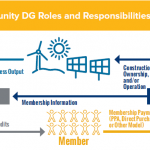
Clearing Up Some Confusion Over Community Solar In New York
Community Solar in New York has a messaging problem. It is confusing, and even some industry professionals have given up in disgust because of aggressive marketing and a lack of clarity.
Fortunately, aggressive marketing is not universal among community solar developers.
Unfortunately, the lack of clarity is almost universal.
How Community Solar Works in New York
The system the New York utility regulator set up for community distributed generation (CDG, a term which includes community hydropower and community wind as well as community solar) is counter intuitive for most potential customers.
As shown in the diagram above, the electric utility pays for a project's...
Tidal flow to power New York City
Verdant Power plans to plunge six electricity turbines into the East River. If the $4.5-million project is successful, the generators will form the first farm of tide-powered turbines in the world. The plan is to attach the machines, which look like small wind turbines, to concrete piles hammered into the bedrock nine metres below the river's surface. As the tide surges in and out, the heads pivot to face the current and the blades spin.
Must Renewable Energy Be Diversified?
Dana Blankenhorn Most renewable energy companies specialize. Solar companies do solar. Wind companies do wind. Geothermal companies do geothermal. Biomass companies do biomass. But a small Canadian merger challenges that assumption. Magma Energy (MGMXF.PK), a geothermal company, said it will spend about $100 million in stock to buy Plutonic Power (PUOPF.PK), which has wind and hydropower projects, and ambitions to get into solar. The combined companies will go by the name Alterra Power. Both companies are based in Vancouver. Size really does matter, crowed Magma CEO Ross Beatty on a conference call announcing...
Internal Hydro International Inc. Enters Phase II of Operations
Internal Hydro International Inc. (IHDR) is now entering the Second Phase of its business plan, which will be deployment of the company's patented energy production technology, called the Energy Commander IV (EC IV). The Company has entered into a sales agreement that will place ten units in applications in the Southwest United States, while placing other units in the Eastern United States in various areas of use.
The Magma/Plutonic Merger
A Great Deal for Plutonic Shareholders, Not bad for Magma Tom Konrad CFA As a shareholder of Magma Energy Corp. (MGMXF.PK), I'm reading through the joint information circular on the proposed merger of Plutonic Power Corp (PUOPF.PK) and Magma to form "Alterra Power Corp." I'm not thrilled with the merger, although I plan to vote for it, now that it's arranged. Overall, I think the merged Alterra will be a stronger company than either company alone. Both companies are in capital intensive niche Renewable Energy industries, so the added scale and diversification of Alterra should better...
Hydropower: The Renewable Energy Elephant in Room
There is a form of renewable energy which accounts for approximately one sixth of world electrical generation, and unlike wind and solar has a natural form of storage which costs a fraction of any other form of electricity storage, and has black start capability. Given all these positive characteristics, it may seem surprising that we have not yet written about it. The renewable energy in question is Hydropower, and the reason we've not covered it before is that the facilities are typically owned and run by governments or diversified utilities. Until now, the only Hydropower investments I have been...
ENDESA Will Invest Euro 286 Million in New Wind Farms and Mini Hydro Plants...
ENDESA (ELE) has received authorisation to build and start up new wind farms and mini hydro plants this year, requiring an investment of Euro 286 million. The start-up of these projects, part of ENDESA's Strategic Plan, will add 277 MW to ENDESA's generation capacity, 252 MW in wind (for a Euro 250 million) and 25 MW in mini hydro capacity (for an investment of around Euro 60 million). Facilities already under construction and expected to come on stream in 2005 include the wind farms at Pena Ventosa and Chan do Tenon in Galicia, Las Hoyuelas in Castilla La...
Campaign for renewable energy begins
Colorado House Speaker Lola Spradley, R-Beulah. and U.S. Rep. Mark Udall, D-Eldorado Springs, co-chairs of Amendment 37—the Renewable Energy Initiative—kicked-off their statewide campaign Thursday with stops throughout Colorado. Amendment 37 would require 10 percent of Colorado's electricity be generated from renewable energy by 2015. The program is scaled beginning with a 3 percent requirement by 2007, 6 percent by 2011, and 10 percent by 2015.
Hydropower project tested on Merrimack
Privately held Verdant Power is developing technology for a new type of hydropower that, unlike conventional hydropower, does not involve the use of dams. Instead, it seeks to capture ''kinetic energy" from the moving water found in tidal streams, rivers, and the ocean, and in human-made facilities such as aqueducts and irrigation canals. This project will be developed on a section of the Merrimack River in Massachusetts.
$3 Billion For Cleantech & Alt Energy
Charles Morand The DOE made public earlier today the amount of money that will awarded to clean power projects in lieu of the usual tax breaks: $3 billion. This will allow project proponents to receive a direct cash grant now instead of a Production Tax Credit or an Investment Tax Credit later on. The guidance document notes the following: "Section 1603 of the Act’s tax title, the American Recovery and Reinvestment Tax Act, appropriates funds for payments to persons who place in service specified energy property during 2009 or 2010 or after 2010 if construction began...
Change Winds Blow for Renewable Energy Income Trusts
Renewable energy is still very much in its infancy, which means that companies in the space are either profitless or high-multiple startups, or divisions of much larger companies (GE Wind (NYSE:GE), or utilities such as FPL Group (NYSE:FPL) and Xcel (NYSE:XEL) which get much of their power from conventional generation.) This presents a dilemma for investors who understand the compelling drivers for the sector, but whose risk tolerance or financial needs indicate an income-based investing strategy. Canadian Income Trusts in Renewable Energy A few Canadian Income Trusts have historically gone some way towards filling this niche....
Focus On Clean Power Income Trusts
Last week, Tom brought you a piece on the Algonquin Power Income Fund (AGQNF.PK), in which he opined that shift in investor attention away from capital gains toward yield might eventually provide a catalyst for the prices of yield-focused securities such as income trusts to rise. So-called utility trusts, or income trusts where the underlying corporation is engaged in utility activities such as power generation, are a common feature of the Canadian income trust sector (the mother of all income trust sectors). A sub-set of utility trusts is the clean power utility trust, where the power generation...
Construction of Shihwa Lake Tidal Power Plant Begins Next Month
This November, the construction of the world’s largest tidal power plant will begin at Ansan City’s Shihwa Lake in Gyeonggi Province, and next year, the construction of an experimental current power plant will start in Haenam County at Uldol-mok. As an aside, this website has a great feature that allows you to listen to a text-to-speach version of this article in either a male or female voice.
List of Hydroelectric Stocks
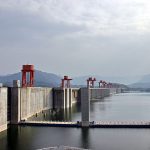
Hydroelectric stocks are publicly traded companies whose business involves converting the energy of falling water into electricity.
This list was last updated on 11/20/2020.
Andritz AG (ADRZF,ANDR.VI)
Brookfield Renewable Energy Partners (BEP)
Contact Energy Limited (CEN.NZ, COENF)
Genesis Energy (GNE.NZ)
Innergex Renewable Energy Inc. (INE.TO, INGXF)
Iniziative Bresciane S.p.A. (IB.MI)
Companhia Energética de Minas Gerais (CIG)
Mercury NZ Limited (MCY.NZ)
Meridian Energy (MEL.NZ)
National Hydro Power Corporation (NHPC.NSE)
National Thermal Power Corporation (NTPC.NSE)
Reservoir Capital Corp. (REO.CN. RSERF)
RusHydro (HYDR.L, RSHYY)
Satluj Jal Vidyut Nigam Limited (SJVN.NSE)
Trustpower (TPW.NZ)
Verbund, AG (VER.VI, OEZVY)
If you know of any hydroelectric stock that is not listed here and should be, please let us know by leaving a comment. Also for...
What A Portfolio Approach To Climate Policy Means for Your Stock Portfolio
Portfolio theory can lend insights into which carbon abatement strategies policymakers should pursue. If policymakers listen, what will it mean for green investors? Tom Konrad, Ph.D., CFA Good Info, Not Enough Analysis I've now read most of my review copy of Investment Opportunities for a Low Carbon World. The quality of the information is generally excellent, as Charles has described in his reviews of the Wind and Solar and Efficiency and Geothermal chapters. As a resource on the state of Cleantech industries, it's generally excellent. As an investing resource, however, it leaves something to be desired. Each chapter is written...