Foundations don’t practice what they preach
by Stephen Viederman Philanthropic foundations are like old-fashioned slot machines. They have one arm and are known for their occasional payout. Although the term “mission-related investing” found its way into the lexicon of philanthropy decades ago, the finance committees of most foundations continue to manage their endowments like investment bankers. Their portfolios give no hint that they are institutions whose purpose is the public benefit. There is a chasm between mission – grantmaking – and investment. The logic of a synergy between the two has yet to take hold. For example, number of reports circulated in the US...
What I Didn’t Say About Obama and New Energy
I was interviewed for a story on NPR's Morning Edition which aired Thursday. Tamara Keith asked me what Obama's election meant for Alternative Energy, and I felt many of my points were downed out by the others she interviewed. Here's what she didn't put in the story: Obama mentioned three challenges ahead in his acceptance speech. He said, "We know the challenges that tomorrow will bring are the greatest of our lifetime: two wars, a planet in peril, the worst financial crisis in a century." Of these three challenges, two were thrust upon him, but he chose to...
Obama’s Climate Plan
James Montgomery Yesterday President Obama spoke at Georgetown University about his plans to broadly address climate change. Ahead of his actual talk, the White House released the gist of what he would propose. The EPA, working with states, industry, and other stakeholders, will establish new carbon pollution standards. "Tough new rules" will be established similar to those that exist for toxins like mercury and arsenic. These new rules, as anticipated, will target existing power plants as well as new ones. The federal government will make available up to $8 billion in loan guarantees for "advanced...
Trump to Health, Education, Small Business, and the Environment: You’re Fired!
Jim Lane Good-bye ARPA-E, DOE, Loan Guarantee program, Energy Star, OPIC, USTDA, NEA, and the Advanced Technology Vehicle Manufacturing Program. Even Big Bird gets the guillotine. In Washington, the White House released its budget requests for 2018, a high-level, 62-page overview of President Trump’s strategy for “Making America Great Again”. Departmental impact In order of percentage impact, the departments are as follows. Defense: Up $52B or 8 percent Veterans Affairs: Up $4.4B or 6 percent Homeland Security: Up $2.8B or 7 percent Small Business Administration: Down $43M or 5 percent Health & Human Services: Down $15.1B...
Shifting the Cost of Pollution
by Debra Fiakas CFA The U.S. Environmental Protection Agency has agreed to review the recently enacted MATS Rule - Mercury & Air Toxics Standards that went into effect at the end of 2011. At least two dozen states and forty utility companies have filed suit against the EPA over the rule, which is intended to cap mercury and other toxic emissions as well as particulates. The rules particularly impact power plants that use coal-fired boilers to generate electricity. The EPA provides an interactive map to see where these plants are located. They are predominantly in the eastern half...
Obama’s New Energy and EPA Appointments
Jim Lane Ernest J. Moniz is the nominee for US Secretary of Energy In Washington, President Barack Obama nominated MIT professor Ernest J. Moniz as US Secretary of Energy, replacing Steven Chu, and nominated Gina McCarthy as EPA Administrator. Moniz is currently serving as the Cecil and Ida Green Professor of Physics and Engineering Systems, as well as the director of the MIT Energy Initiative (MITEI) and the Laboratory for Energy and the Environment. He was formerly undersecretary of Energy and associate director of the White House office...
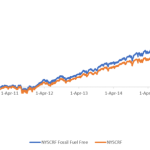
New York State Pension $ 22 Billion Poorer By Not Divesting 10 Years Ago
Research firm Corporate Knights revealed that the pension fund would be $22 billion richer had it divested from fossil fuel stocks in 2008. That's almost $20,000 for of each of the pension fund’s 1.1 million members & retirees.
A new in-depth analysis by the research firm Corporate Knights, shows that New York State pension fund would be $22 billion richer had it divested from fossil fuel stocks 10 years ago. That works out to almost $20,000 for of each of the pension fund’s 1.1 million members and retirees. To perform their analysis, Corporate Knights looked at the stock holdings of the pension fund in...
Our Energy Bubble
Tom Konrad CFA Our energy policy looks like a bubble. Bubbles are a social phenomenon at least as much as they are a financial phenomenon. At the top of bubbles, participants ignore glaringly obvious risks. In October 2007, Meredith Whitney pointed out the almost glaringly obvious fact that Citigroup was paying out more in dividends than it was earning in profits (i.e. it was being run like the US government, but without a friendly Federal Reserve to bail it out by printing money.) She said that Citigroup would need either to raise capital,...
What A Portfolio Approach To Climate Policy Means for Your Stock Portfolio
Portfolio theory can lend insights into which carbon abatement strategies policymakers should pursue. If policymakers listen, what will it mean for green investors? Tom Konrad, Ph.D., CFA Good Info, Not Enough Analysis I've now read most of my review copy of Investment Opportunities for a Low Carbon World. The quality of the information is generally excellent, as Charles has described in his reviews of the Wind and Solar and Efficiency and Geothermal chapters. As a resource on the state of Cleantech industries, it's generally excellent. As an investing resource, however, it leaves something to be desired. Each chapter is written...
Chinese Green Subsidies: When Lifting All Boats Becomes Bailing Them Out
Doug Young Bottom line: Strong response to Tesla’s latest EV in China and a major new solar plant plan from SolarReserve reflect Beijing’s strong promotion of new energy, which is also creating big waste by attracting unqualified companies to the sector. A series of new reports is showing how Beijing’s strong support for new energy technologies is benefiting both domestic and foreign companies, as China tries to become a global leader in this emerging area. But the reports also spotlight the dangers that come with such aggressive support, which often leads to abuse of subsidies and other...

US Ethanol Industry Upset With 2019 Renewable Fuel Standard Proposal
The 2019 proposed US Renewable Fuel Standard proposed volumes attracted a major raspberry from the ethanol industry.
As the American Coalition for Ethanol noted:
“Unfortunately, EPA continues to take actions which undermine the letter and spirit of the statute and harm the rural economy. While refiners are reporting double-digit profits, the heart of America is being left behind. Farmers are losing money while refiners have the best of both worlds: fat profit margins and minimal RFS compliance costs. EPA needs to discard its refiner-win-at-all-costs mentality and get the RFS back on track.”
“While the proposed rule purports to maintain the 15-billion-gallon conventional...

Trump Administration Flip-Flops On Oil Refinery Waivers Again, Farm Groups Protest Again
by Jim Lane
In Washington, what must have become a weary if vigilant posse of the nation’s biofuel and farm advocates are out on the hustings again this week, over a fresh attack on the US Renewable Fuel Standard, this one led by officials in the Trump Administration, if a story reported by Bloomberg stands up against scrutiny.
What has been described as a “misinformation campaign spearheaded by Senator Ted Cruz” is seeking to overturn a unanimous court decision that would halt the Environmental Protection Agency’s abuse of Small Refinery Exemptions (SREs) under the Renewable Fuel Standard.
The backstory
In a unanimous panel, the...
The EPA’s Carbon Rule: Likely Stockmarket Winners
By Harris Roen Greenhouse gas emissions by economic sector A seismic shift in the power generation landscape is starting to sink in. It has been two weeks since the EPA announced its new proposed carbon rules, one of the flagship efforts of the Obama Administration to address climate change. This shift is meant to move the country in the direction of inevitable changes coming to the energy economy. It is important for investors to know which companies and sectors stand to benefit from the...
A Cleantech VC Who is Unconvinced of Man-Made Climate Change
David Gold Go ahead call me a hypocrite. I claim to be a cleantech venture capitalist yet I tell you here and now that I am not convinced of anthropogenic (human-caused) climate change (aka global warming). And I will audaciously tell you that my convictions on climate change in no way run contrary to my strong belief in the need for a cleantech revolution Many supporters of clean technologies make it seem as though anthropogenic climate change is an absolute fact. To some of them anthropogenic climate change is almost like a religion where any debate...
How New England Can Eliminate Oil Use For Single Family Homes for Less Than...
Chris Williams We can use simple, effective, and proven policies that have been used to supercharge the New England solar PV industry to incentivize renewable thermal technologies and eliminate oil use for single family homes. Here's the best part, the policies will be cheaper than solar PV, they will create more local jobs per kW installed and displace more expensive fuel. At Renewable Energy Vermont 2012, I delivered a presentation on how a production-based incentive for renewable thermal technologies, like the $29/MWh incentive in New Hampshire, would be cheaper than the current solar PV incentive in Vermont and...
What Trump’s Victory Means For The Bioeconomy
Jim Lane In Washington, Donald Trump captured the US Presidency in an upset victory that confounded pollsters and political pundits even as it delighted supporters of his maverick candidacy based on themes of immigration and trade reform coupled with a message that government policies of the past generation had failed for too many Americans. An unexpected series of wins across US Midwestern states – capturing Iowa, Pennsylvania, Wisconsin and Ohio which had gone for Obama in 2012 – provided a comfortable margin of victory in the Electoral College and the popular vote. 5 Themes Some immediate themes emerge...